


Opening Claim
In my first essay on responsibility, I argued that affirming existence means accepting responsibility for a world we did not create. We emerge into the world shaped by the generations before us, and bear the burden of responsibility for ourselves and future generations ahead. Civilization, then, is the organization of that responsibility at scales greater than any individual could achieve alone.
As civilizations grow and gain more capacity to prevent suffering, preventing that suffering increasingly becomes a collective responsibility rather than an individual burden. My claim is that modern institutions often fail this responsibility by concentrating authority while displacing responsibility back onto individuals through moralizing, bureaucracy, and institutional incentives.
By institutions, I mean the durable organizations through which societies coordinate responsibilities that no individual can bear alone; governments, markets, corporations, and other structures of collective action.
By moralizing, I mean the habit of transforming practical and institutional problems into questions of individual virtue. Rather than asking how we should collectively organize to reduce suffering, we ask whether those who suffer deserve relief in the first place.
The result is a culture that blames individuals for suffering that civilization has already acquired the capability, and thus the responsibility, to prevent.
The Problem of Moralized Suffering
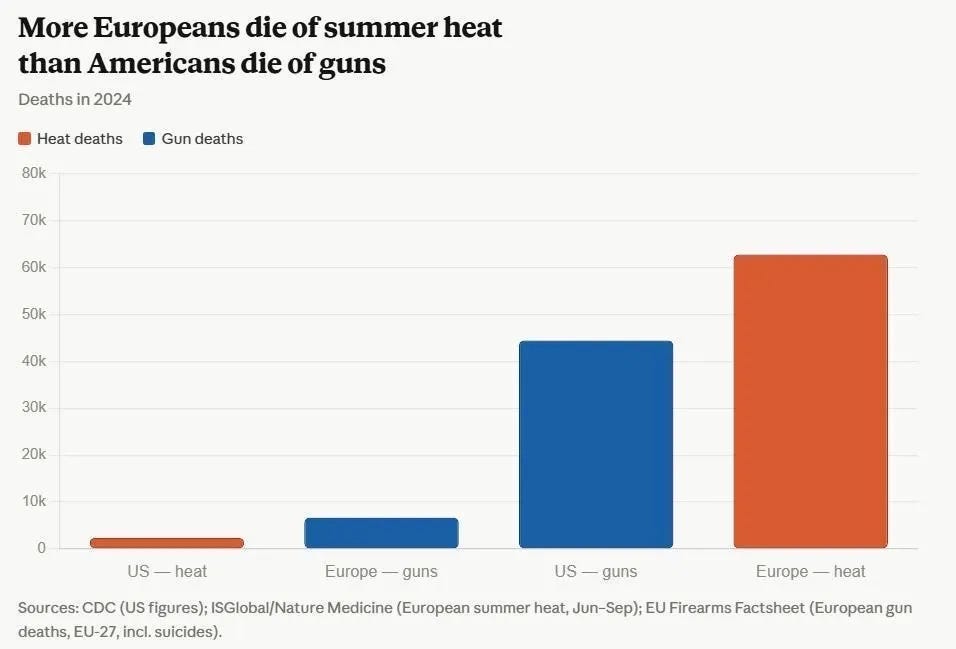
Undoubtedly by now, you are aware of the record heatwave affecting Europe. It is omnipresent in the news and online right now, and along with that, you’re probably seeing a lot of discussion about the chart above. You can’t doomscroll for five minutes right now without running into people arguing over this idea of American gun deaths versus European heat deaths.
This framing of the debate as a moral question has become a recurring feature. For some, choosing air conditioning is the choice of wasteful excess, and going without is a sign of environmental virtue. We can see what this does already. Rather than asking why European infrastructure remains poorly adapted to these increasingly predictable heat waves, we are asking whether individuals deserve air conditioning at all.
These are major issues and hundreds of thousands of people are dying every year from things that we, as people participating in society, should be able to prevent. Why can’t we do that?
This article by Hannah Ritchie, Oxford Data Scientist, helps begin to clarify and shed some light onto that. Her conclusions are correct in that the framing of these issues as a contest misses the mark. They are both situations that because of the status quo, one side deals with and the other finds morally reprehensible.
Both sides are doing this moralization. Taking the choice between getting air conditioning and not, and making it into an issue of moral right versus wrong. Public attention is shifted away from the institution and toward the individual. The debate becomes about ordinary people making choices instead of whether our institutions are adequately fulfilling their responsibilities.
There are truths to many of the moralizer arguments. The environment is paramount and needs to be one of our greatest priorities, if not the greatest. Individual responsibility is real and we need to account for it. Importantly though, is how often we don’t realize that these issues arise due to the design, or lack thereof, of the institutions that should be responsible for them in the first place.
By now, you can see that I’m not really just talking about air conditioning. A similar rhetoric appears across the landscape of modern issues. The housing crisis becomes a discussion on tiny homes and minimalism. The healthcare crisis becomes lifestyle discussion. Everything becomes moralized and politicized.
Perhaps the clearest historical example is the individual carbon footprint. The concept of the carbon footprint is a tool being pushed by institutions to rid themselves of responsibility. The individual carbon footprint was popularized by BP during a massive marketing campaign to shove the blame for climate impact back down onto the average person rather than have to pay up for their own damages.
Memetic online culture today reinforces this process by rewarding moral performance over institutional thinking. These small moral purity tests become substitutes for the far more difficult work of institutional change.
“I would never use air conditioning, that’s terrible for the environment,” makes one feel better than, “My government isn’t providing the opportunities and infrastructure for our people to not die of preventable deaths.”
Thus a cycle where institutions put the blame onto the collective to bear the responsibility and not have to serve humanity, and the individuals among the collective blame each other in order to not have to put in the effort to change the institutions.
Our current tragedy is that Prometheus stole us the fire, we built temples to hold it, and now we fight each other tooth and claw to keep each other out and away from its warmth.

Civilization Exists To Be Responsible
“The public consists of all those who are affected by the indirect consequences of transactions to such an extent that it is deemed necessary to have those consequences systematically cared for.”
- John Dewey (1927), The Public and Its Problems, p.15-16
As we began to understand in the previous essay on responsibility, we enter our stories from the midpoint. We inherit this world of chaos that we didn’t choose, and find ourselves among an infinite web of relations that we are already forced into participation with. We inherit the obligations and responsibilities that we must act upon. The same goes for our institutions, the totality of which is civilization itself.
Civilization is the living network through which our institutions organize our responsibilities. The effort of countless generations of individuals which has transformed their isolated actions into systems capable of serving the billions of others we share this world with.
This insight is what I take from Hegel’s concept of Ethical Life (Sittlichkeit). In my writing on free will I discussed this idea in that our freedom is not achieved by escaping institutions but by participating in them. When properly understood, institutions allow individuals to accomplish the impossible compared to acting alone.
John Dewey is a similar influence but from another direction. He argues that modern society creates consequences that affect people far beyond those that are immediately involved. When those consequences continue to ripple outwards, responsibility can’t remain private. A public emerges and so does the need for institutions capable of collective action.
Civilization therefore doesn’t just arise because people desire power. It arises because our responsibility scales with the size of the problems we face. Individuals can help each other survive, but we alone can’t build the hospitals and energy infrastructure and other massive systems that we’ve come to depend on.
So rather than surrender our agency, we pool it together. Institutions are not meant to replace individual responsibility but to organize it, extending our capacity to care beyond the limits of any single life. Every institution is an answer to a particular burden that human beings couldn’t handle alone. Civilization itself is the ongoing project of transforming individual acts of responsibility into collective ones.
I’ll use my old pal, Prometheus, again to summarize. The fire had to be protected and passed from one generation to the next. We received an inheritance of a great gift, but the things we inherit become our obligations. He created the first responsibility that no individual could carry alone.

The Responsibility Gradient
“Who says organization, says oligarchy.”
- Robert Michels, Political Parties, 1911
I have repeatedly hammered on the point that when we have the capability to affect consequences on others, we have the responsibility to be good stewards of those consequences. Healthy institutions must then do the same. We place our agency and capability into institutions in the form of authority. Institutions should be judged by one criterion above all others. Do authority and responsibility remain aligned?
Institutions entrusted with greater authority also inherit greater obligations. The ability to affect the lives of many people carries a proportional responsibility for their well-being.
Modern institutions invert this relationship. Authority accumulates upward while responsibility is displaced back down to the individual. The institutions most capable of affecting the most people often become the least accountable for it, while individuals inherit moral responsibility for problems that we possess little meaningful power to solve.
I call this the Responsibility Gradient. In healthy institutions, authority and responsibility rise together. In unhealthy ones, authority rises while responsibility falls. The greater an institution's capacity to shape society becomes, the less accountable it becomes for the consequences of that power.
Authority rises when people choose to cede their agency to avoid making decisions or bearing responsibility.
Robert Michels1, in his 1911 work Political Parties, explains why organizations centralize their leadership. Problems are too complex and specialists are required. As the organizations grow, decision-making inevitably becomes concentrated among relatively few people.
These are facts of modern civilization and we couldn’t function without these complicated systems, but the problem isn’t solely in the concentration of authority. It is when authority rises and responsibility no longer rises with it.
“Power corresponds to the human ability not just to act but to act in concert.”
- Hannah Arendt, On Violence
Philosopher Hannah Arendt’s work often speaks to ways in which this happens. Bureaucracy diffuses personal responsibility when these organizations grow. Everyone follows procedure and no one is accountable, while the institution begins acting like an impersonal force of nature.
Institutions don’t announce that they are abandoning responsibility. Instead, responsibility reappears elsewhere. It returns to citizens as lifestyle choices, to consumers as purchasing decisions, and to workers as personal resilience. It appears to the mislead Europeans as heat stroke and to the deceived Americans as public shootings.
The personal carbon footprint became enormously successful not because it was entirely false. Individual actions do matter. It succeeded because it redirected public attention away from institutions capable of acting collectively and toward individuals whose actions, while meaningful, could never solve the problem alone.

Moralizing, Optimizing, and Traumatizing
Inside the institution, whichever it may be (even society at large), this failure of responsibility is hard to see and rarely feels like failure. It feels like guilt, exhaustion, anxiety, resentment, and moral judgement from the rest of the collective. Surely online you’ve seen people complain of burnout, being terminally online, being worn down by “Late Stage Capitalism (more on this in a later essay). These things are all symptoms of the collapse of the modern institution. They follow a visible pattern when we take notice of trends.
First, when responsibility is displaced downward, individuals feel these pressures, and receive new ways to blame themselves and each other. As highlighted by previous examples, moralizing turns these structural problems into questions of virtue.
Following the blame, though, is what people do with it. As always, humans adapt. People react to institutional failure by trying to become better ourselves. We OPTIMIZE. Another wonderfully omnipresent cultural artifact of our times. Looksmaxxing.
These things aren’t necessarily bad in themselves, but become a problem when that self-improvement becomes a substitute for collective responsibility. Philosopher Byung-Chul Han describes this as a form of power that no longer even needs to command us directly because we learn to command ourselves.
Finally, the trauma. The society-wide psychological result that occurs from the social production of private distress. People begin to experience structural failures as their own personal inadequacy and instead of concluding that the system failed to uphold its side of the deal, they think “I failed to optimize correctly.”
“The current ruling ontology denies any possibility of a social causation of mental illness.”
- Mark Fisher, Capitalist Realism
As we claw at the doors of the temple in hopes of getting in to bathe in the warmth of the sacred fire, the modern keepers of the flame slide us a broken mirror under the door and ask us how we could possibly be cold.
When Morals Turn Against Humanity
“Act so that the effects of your action are compatible with the permanence of genuine human life.”
- Hans Jonas
Environmentalism begins from one of the most important moral insights of modern civilization. Human beings do not stand outside nature. We depend on clean air, clean water, stable climates, functioning ecosystems, and a livable planet. At its best, environmentalism is not anti-human. It is humanism expanded far enough to recognize the conditions that make human flourishing possible.
The problem begins when that insight mutates into suspicion toward humanity itself. The same pattern appears in places far beyond air conditioning. In memetic online environmentalism, comfort is equal to wealth and decadence. Consumption becomes personal corruption. Having children becomes selfishness. The human being slowly stops appearing as the subject of moral concern and begins appearing as the contaminant to be reduced.
Antinatalism, harkening back to my essay Against Philosophical Pessimism, often follows the same pattern from a different starting point. Its strongest versions begin from compassion. No one consents to being born. Creating life means creating a being that is doomed to suffer. These are serious concerns and they deserve to be treated seriously.
Here especially the moral concern can invert. The goal shifts from reducing suffering to reducing humanity. Rather than bear our responsibility to continue human flourishing, the future is prevented wholly.
Hans Jonas gives us a better way to think about this. In The Imperative of Responsibility, he argues that technological civilization creates obligations toward the future. His imperative is the above quote, “Act so that the effects of your action are compatible with the permanence of genuine human life.” This is one of those statements that hit me like a truck. This encapsulates so much of my own ethical thought and the work I’m trying to do here.
That is the missing humanism. If suffering matters, then the answer is not to make humanity smaller. The answer is to make human life less needlessly cruel. If the environment matters, it matters because life matters. If future generations matter, then our task is not to resent their possible existence, but to build institutions worthy of their arrival.
The moral failure is not wanting air conditioning. The moral failure is building a civilization powerful enough to reduce suffering, then teaching people that needing relief is the problem.

Objection!
It is only fair to attempt to quell some of the potential objections one may have against these ideas so far. We can easily anticipate a few and address them quickly.
The first is that comfort has costs. Air conditioning requires energy. Modern medicine requires infrastructure. Housing, transportation, food production, and public health all require materials, labor, and tradeoffs. This is true. My claim is not that every form of comfort should be pursued without limit, or that reducing suffering is always simple. The claim is that preventable suffering deserves moral weight. If a society can reduce suffering without destroying the conditions of future life, then that responsibility falls on those institutions which would leave that suffering in place.
The second objection is that technology created many of the problems I am discussing. This is also true. The very fire we received from Prometheus warms homes and burns forests. Fossil fuels powered modern civilization and destabilized the climate. This doesn’t mean that the answer is abandoning technology. We already possess the fire, now we must tend to it. A civilization that has inherited powerful tools has also inherited the responsibility to govern them wisely.
The third objection is that personal responsibility still matters. I couldn’t agree more, and point to the foundational essay upon which this one exists. Nothing in this essay erases the responsibility of individuals, and individuals make up the institutions that I write about here. We should conserve energy where possible. We should care for our health. We should looksmaxx. Wait, okay not that one?
We should make responsible choices within the range of agency actually available to us. Again, the problem is when a problem is of the large institutional scale of responsibility and we not only take the blame and trauma of that problem onto ourselves, but pass it off to others, rather than demand action from our institutions.
The fourth objection is that criticizing anti-human environmentalism or antinatalism is the same as dismissing environmentalism or concern for suffering. Of course, this is not the case. The strongest environmentalism begins from care for life. The strongest concern for suffering begins from compassion. My criticism is directed at the point where these concerns invert, where protecting life becomes suspicion toward humanity, and reducing suffering becomes reducing the number of future sufferers rather than improving the conditions of life.
These distinctions matter because the goal is not indulgence or escapism. The goal is responsibility. Individuals should bear the responsibilities that belong to individual agency. Institutions should bear the responsibilities that belong to collective power. Civilizations should be judged by whether they organize that power toward the flourishing of the people who live within them, and the people who will inherit what they leave behind.

Conclusion
So the answer here is obviously not to abandon environmentalism, or technology, or institutions. Of course, it is not to abandon personal responsibility either. All of these are part of the inheritance that we emerge into this world alongside and must make use of to further our lives and the lives of those coming after us.
A humanistic environmentalism must show how we can flourish without destroying the conditions that allow flourishing to continue. A responsible technological civilization treats each new power as something that must be governed wisely. A serious account of personal responsibility asks individuals to act within the range of agency they actually possess, while still recognizing that many problems now exist at scales only institutions can meaningfully address.
The layers of responsibility from individual, to institutional, to civilizational are formed interconnectedly in this dangerous and dynamic world in which we all must live together. We can’t eliminate every hardship and will undoubtedly continue to suffer. The future will remain open and surprising to us. We can’t do it alone, and seemingly no institution can fix these problems entirely either.
However, as history shows us, some forms of suffering that once were existential threats thought of as fate are now long behind us. Once our civilization gains the ability to prevent a form of suffering, that fate can become a problem of organization, priority, and responsibility.
This is why the air conditioning debate matters beyond air conditioning. It isn’t about whether or not people should buy a window unit or save more energy. It is about asking our governments why hundreds of thousands of heat deaths become our problem rather than a failure of preparation. It is about why we must feel guilty for needing help from the very institutions we forged to help us.
Civilization was not built to leave us alone with that mirror. Prometheus did not steal fire so humanity could prove its virtue by remaining cold. Fire was the beginning of our refusal to abandon one another to the indifference of the world.
It was also the beginning of obligation. Once we possess it, we have to tend to it. We protect it and pass it forward. The fire of civilization becomes children’s hospitals, sustainable power grids, and cooling systems.
If affirming existence means accepting responsibility for a world we did not create, then civilization is how we accept that responsibility together. The task ahead is to build institutions worthy of the power civilization has already acquired, and to stop teaching people that needing relief from preventable suffering is a failure of character.
We judge civilization and should be judged by the suffering that we refuse to normalize, and if the fire we inherit remains brighter and available to more people than when it was passed to us.
Every age has its burdens and the fire that it inherits. So, every age has to decide what kind of fire-keepers it will become.
These are my Lamentations of Late.
- JD
Michels later joined Mussolini and the Italian Fascists, and is a controversial figure. I think the work in Political Parties is still very relevant today even though he was deeply flawed and became disillusioned with the other options of his time.
The tendency of authority to grow without concomitant responsibility is one of the most important issues of our time. Look no further than the current US government, or the AI billionaires who fear monger about the technology taking everyone’s jobs but then act as if they’re powerless to do anything about it. The truth is, they don’t care what happens, because they won’t be held responsible.
As a lawyer, it’s depressingly common to see partners who have no clue what’s happening on a deal and act essentially as dead weight but who get all credit and make way more than everyone else. Of course, they’re more than happy to lay the blame on someone else if anything goes wrong. I think that if you’re going to get the rewards of leadership, it’s incumbent on you to do the hard job of actually leading and taking responsibility.
This is the useful frame: moralizing individual choices often hides institutional failure.
People should act responsibly. But responsibility is not the same as being handed every consequence of poor planning and told to cope better.
If homes, workplaces, schools and public spaces are not built for predictable heat, the dignity question is not “why didn’t people make better choices?”
It is: who designed a system where survival depends on private improvisation?