

Field Notes and Fragments #1: The Top Post on Philosophy Reddit??
Weekly observations from an unfinished journey

As many of you know, I’ve recently undergone my second major surgery in three months. Being temporarily immobilized has given me a lot more time to focus on my mental pursuits (with a big thanks to my wife for taking care of our baby boy and my mother for coming to help us around the house).
The response to the last article has been overwhelming. Within twenty-four hours of posting it to r/philosophy it became the top post of the day and has since been viewed more than 180,000 times.
One of the main goals with this substack is to foster a community of learning so that we can explore complicated ideas together. Most importantly, this level of engagement shows me that people are interested in these conversations.
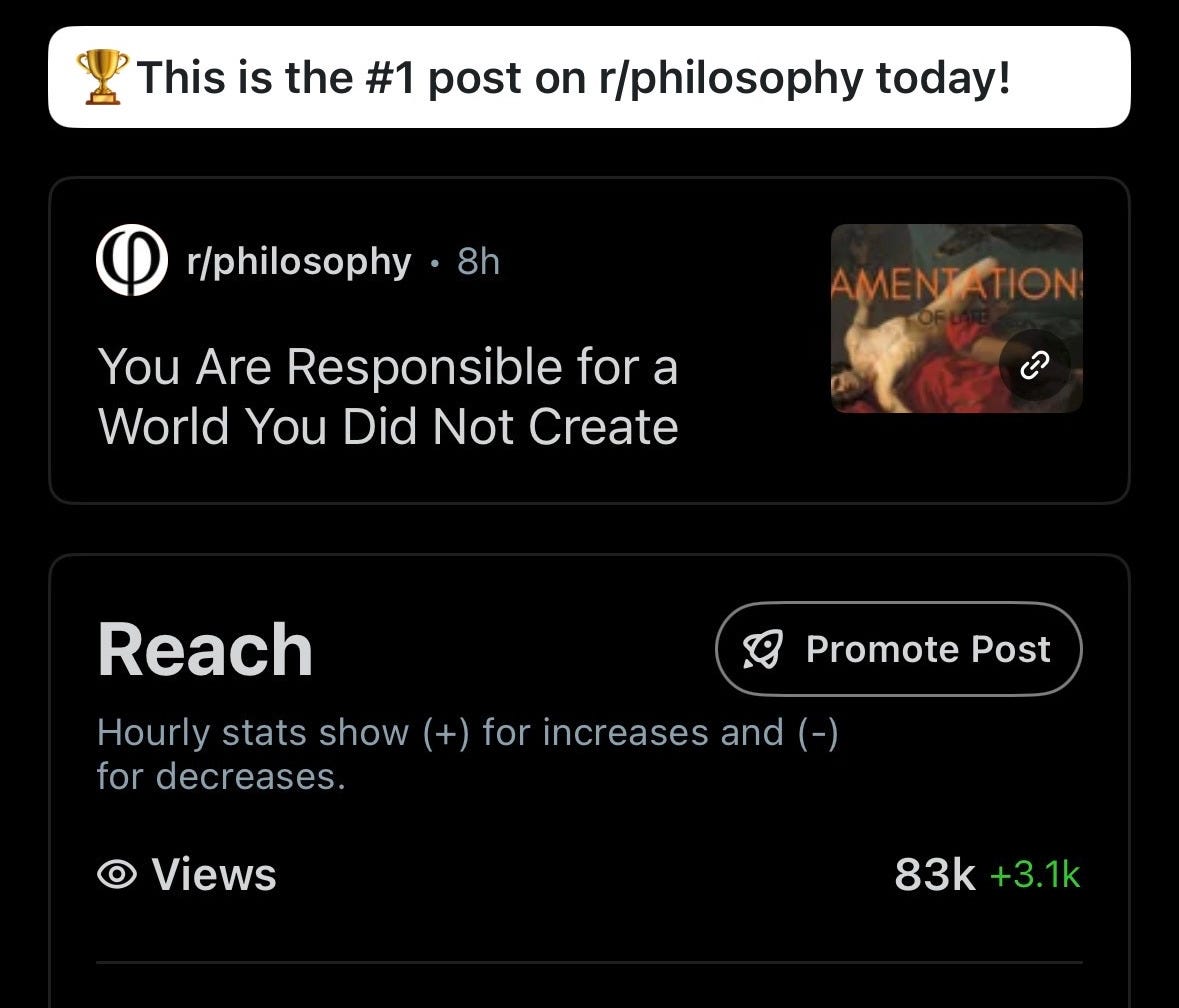
I’m not usually someone who cares much about this sort of thing, so I’ll try not to let it influence what I would already be doing with the project. However, I just wanted to be transparent and show as much behind-the-scenes as possible.
Alongside the weekly Wednesday essays, which will continue to build upon each other as part of the “main series” project that Lamentations is founded on, I’ll be starting this Field Notes and Fragments as a weekly series.
I'm still figuring out exactly what these Field Notes will become, but for now think of them as notes from the larger project. Ideas for future essays, things I'm reading, interesting developments, and whatever philosophical rabbit holes I've wandered into that week.
We humans love our lists, so we’ll start with the philosophical topics that are most interesting to me right now. I’ll recommend some other philosophy substacks to check out, the ideas I’m working out for future articles, and I’ll finish each week with a mini-review of the last thing I read and some thought-fragments or aphorisms I’m chewing on.
I’m also a novice oil painter and always seeking out public domain oil paintings to show off, so I’ll continue to sprinkle those throughout the articles.
These Field Notes will hopefully provide a more natural place for conversation as the project develops.
Let’s go.
Top philosophy “problems” I’m into currently:
1. Bostrom’s Simulation Argument -
I spend a significant amount of time every day thinking about this.
I generally find the simulation argument plausible and that there is a substantial probability that the hypothesis is correct (we are living in a simulation).
For such a short argument, it's remarkable how many implications it seems to have while changing almost nothing about how we actually live our daily lives. I’m always excited to discuss this with people and have a lot of plans for future essays focusing on simulation-adjacent ideas.
2. Free Will -
The problem that just won’t go away!
I’ve traditionally fallen on the compatibilist side of the debate. After thinking so much about responsibility and ethics lately, I have been trying to intentionally argue myself into other views of free will just to explore it as much as possible.
3. Animal Intelligence -
This video really started a wild ride of ideas. The idea that we might actually be closing in on communicating with an animal species is one of the most exciting things going on right now. The researchers at Project CETI have been doing some amazing work with Sperm Whale communication. They might even have a type of communication similar to some of our tonal languages.
The implications of this alone are huge and I honestly haven’t processed them yet. Veganism, lab grown meat, and animal rights, especially in the face of climate change, are already huge issues that people just aren’t facing right now. If we really are communicating with another species that is on a similar level to us, I don’t know how people are going to take it. It’s exciting and a little scary.
4. AI -
The big boogeyman right now. Everyone is both sick of hearing about it and waiting nervously to see if it actually is going to take over the world and kill everyone.
Scott Alexander’s latest post on AI opinions got me thinking about it again, and I’ve decided I need to be working on this and not just ignoring it. I definitely recommend checking it out. I’ll probably put out something like this soon and try to find a balance of talking about AI without making everyone want to kill me.
5. American politics, economics, and capitalism -
The ever-present specter lurking over everything right now. Honestly, writing about the old classic philosophy problems and pretending that this stuff isn’t what’s on everyone’s mind has felt a bit escapist and naive.
I’m aware, and building up to it in the main series articles.
I have a lot to say about all of this stuff, and am looking forward to getting into it, but I’m hoping to build up the rest of the project first so that we can have some real communal discussion and try to actually work some of these problems out.

Substacks you should check out:
1. Unsolicited Advice | Joseph Folley -
I’m not under any impression that there is anyone who follows me here and hasn’t already heard of this page and his YouTube channel, but I felt the need to mention it anyway. This kind of accessible and friendly philosophy content is really important to me.
The care and detail that goes into his discussions and video topics is apparent, but also easy enough for an ordinary person to put on while doing the dishes or whatever. If we want to make these big ideas and concepts a bigger part of everyday life, then this is one of the ways I see it happening.
His videos on Gen Z and Nihilism, Philosophical Pessimism, Camus, and other favorite topics really inspired me to return to my love of philosophy and gave me the motivation to start this project so I’ll always be grateful for that.
2. Dr. Gregory B. Sadler - That Philosophy Guy -
Another heavy hitter, Dr. Sadler is a seasoned professor, writer, and YouTube philosophy creator. He has more than enough videos to facilitate an entire self-education in philosophy for the dedicated viewer, and is also constantly posting new and interesting personal anecdotes, inquiries of his own, and conversations with others.
I personally found him through his supermassive Half-hour Hegel series on Hegel’s Phenomenology of Spirit, which is a nearly 400 video long series tackling the infamous philosophical work. He does an excellent job of taking the book section by section and making it digestible. I often throw this on when I’m sitting up late at night taking care of the baby and want to melt my brain with some good ol’ Hegel.
3. A Scientist | iamascientist -
A fellow small substack, I lucked into finding this one and have been fascinated. The recent Self and Not Self essay was a really fun and interesting read, and around the same time that I have been exploring these ideas myself.
Highly recommend.
Upcoming essay ideas I’m wrestling with:
1. Free Will (again!) -
Not just one of the big problems I’ve been thinking about, but a natural expansion from the recent articles. If we made the decision to affirm life, and then begin with a first philosophy of ethics, then what does it mean to make these kinds of choices, and how do we do it? Do we have free will? What does that even mean?
I’ll certainly have to address this soon, I’m just deciding on when that’s going to be.
2. Immortality -
Another no-brainer and potential controversial topic (which I’ve enjoyed playing with controversial and subversive topics thus far). If we’ve decided that living and reducing suffering is good, then living FOREVER must be REALLY good, right? Right??
We’ll see.
3. Language -
As a linguist, and following up on the ideas about inherited participation in my last essay, I’m interested in doing a more specific deep dive into language. Especially how language is one of the responsibilities that we inherit, how it constrains and empowers our thoughts and actions, and how we change it for the future.
4. Violence and Guns -
The military guy (who’s actually some kind of lefty weirdo?) talks all about violence and guns. Sounds like a good article, still figuring out how to approach this one.
Is violence ever justified? What are we supposed to do about guns? This one will probably take a while for me to cook up to a workable state, but it’s one of the irons in the fire for sure.
If anyone has any questions or suggestions for this one in particular, I’m especially interested. This feels like a space that other contributors on philosophy substack have like zero information and I could provide some real value.
5. Philosophy and Comic Books -
I’m planning on writing a guide on how to “get into philosophy” in the same way that someone might get into comic books. They both have such a complex and dense history of publication, and don’t really reward just starting “at the beginning”.
There’s a lot of interesting parallels here and I’ll probably do this one as some type of bonus article in the near-to-mid future.
Out of all of the sections in this piece, these upcoming ideas are the ones I’d most like feedback on, if you see one of interest or anything sparks some type of feeling, please reach out or drop a comment about it!
The last thing I read:
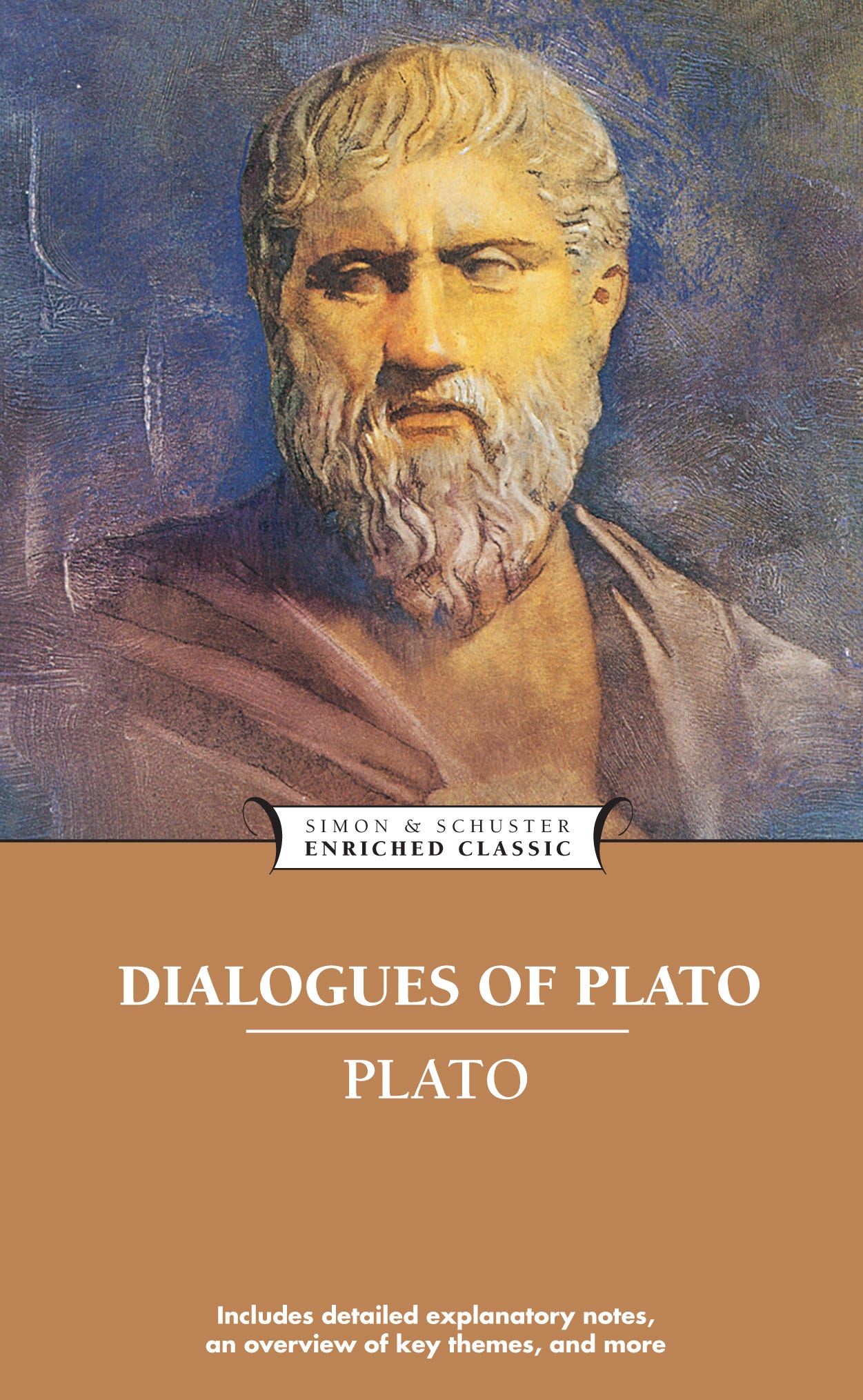
Dialogues of Plato - Plato, specifically the Simon & Schuster Enriched Classic Edition. Pretty solid, easy to follow, good footnotes.
After starting this project and all the talk of going back over the big problems from first principles, starting philosophy at the foundational problems, I decided I’d start a bit of a personal reading journey in the same way.
I hadn’t touched any of the classic Greeks since I was a young man, and have been really enjoying rereading them. It’s an easy read, I finished the collection within a day of on-and-off reading while in bed post-surgery.
Personal favorite and internet philosophy phenom, Slavoj Žižek, has mentioned how, for him, Socrates really was the first philosopher. Through his inward turn and the development of the dialectical inquiry, he pioneered the way that we seek truth and knowledge in our reality. Žižek also jokes that Athens really was right to execute Socrates for “corrupting the youth”, which is the true job of the philosopher. I won’t waste time or ruin the joke by explaining it, but I will add one thought of my own.
My God, Socrates is insufferable. Reading these is hilarious because you can feel the frustration of the interlocutors in each different dialogue. Surely the comparison has been made a million times, but Socrates really was the proto-“Debate-me-college-campus-bro”.
Of course, I mostly joke, and we only even have the ability to look back at things in such a way because of Socrates, but it’s fun to make the comparison as you read through the works.
One last little comparison. Perhaps you’re starting to get to know me by now and you’ll see this one coming, but it’s with Hegel.
Several times in the dialogues, the person Socrates is speaking with just flatly tells Socrates, “Hey dude, this is annoying and I’m obviously not getting it. Please just tell me how I should think about this.”
Socrates responds with “Okay yeah I’ll definitely do that” and then ignores the request and beats the person over the head with his normal questioning style.
This just reminds me of something I’ve brought up about Hegel several times now throughout my essays. For Hegel, sometimes we must grapple with the complex and overly complicated language and ideas, because only in overcoming them ourselves can we see the next step in thinking unfold within our minds. Having things explained more simply just won’t trigger this process for us.
For Socrates, he believed that humans had an immortal soul that innately contained all of the knowledge, and we are simply recalling it when we engage in philosophy or inquiry.
I’ve been thinking about this a lot in relation to my stated goal of taking complicated ideas and making them more accessible. I’m trying to strike a balance of explaining things and showing people that some concepts might need to be undertaken in a more self-challenging type of way. I’ll continue to work on this.
Fragments
or little things I’m still working out
I’ve been thinking about the power of myth and fiction in philosophy lately. Everyone knows how much the existentialists used these in conveying their ideas. Specifically, Albert Camus and his Myth of Sisyphus.
I take an immense amount of inspiration from Camus, and I think I’ve mentioned previously that I’ve been noticing a lot of people in online communities speaking poorly of him (or just straight up saying that he’s not worthy of being called a philosopher). This kind of thing is just exactly what it takes to ragebait me, so I’ve tried not to engage with the obvious nonsense, but I have been thinking a lot about his work.
Camus’ use of fiction and myth to explain his ideas was brilliant, and continues to expose beginners to some of the most interesting ideas in philosophy to this day. Being able to show the reader a character that they can relate to (or be repulsed by) is invaluable when trying to explain such complicated topics as meaning and the Absurd.
I’ve been questioning going down a similar path myself. I’m still thinking of how to do this, but I have a basic outline of the idea:
I’m interested in taking the overall philosophical ideas that we reach in the journey of Lamentations of Late and doing a bit of engineering. Turning them into a philosophical “system” of their own, and then working them into a different ancient myth, and writing the story. Both as a fun experiment and a bit of a tribute of my own to Camus.
I don’t want to get too ahead of myself or spoil anything yet, but this is the basic fragment I’ve been mulling over. I’ll keep forging away and keep you updated.
Well, that’s all for the first Field Notes and Fragments. Let me know what you think. Where do you fall on the free will debate? Are we in a simulation? I’d love to hear from you as well as suggestions for future editions, likes/dislikes, etc.
I’ll be back on Wednesday with another main series essay, and we’ll keep this thing rolling along.
These are my Lamentations of Late.
- JD