

"The Beginning Comes Later" — How Philosophy and Comic Books Rewrite Their Own Origins
Lamentations On Philosophy of History and History of Philosophy

Opening Claim
We often think of the traditions of our lives as having their own lore and developments that we can study from the beginning, from philosophy with its rich and extensive schools of thought to music and its near-infinite genres and sub-genres. Historical study itself may seem to have a beginning that a scholar may start with before progressing along a set chronological curriculum.
Interestingly, comic books can help to show us that this isn’t exactly the case. Philosophy, comic books, and even history often seem to move forward by repeatedly returning to their beginnings. The past remains fixed in occurrence, but unfinished in meaning.
So I claim that what count as our origins, historically and personally, are retroactively constituted by the stories of our lives as they develop. New ideas and thinkers inherit and interpret an accumulated history that changes how the first stories are understood. This can give us insight into our own lives and into the paths we follow through education.
Where Are You Supposed to Start?
As I work on this project and the development of my own philosophy through my writing, as well as reflecting on how I want to teach philosophy to my kids, the question of where to begin appears to me often. I’ve written about the idea that explaining something’s origin is not the same as explaining the thing itself. For example, explaining that our feelings emerge from biological processes does not mean those feelings are unreal or invalid.
However, what does explaining the origin of something do? How do we do that? What about for philosophy itself? I began thinking about these things throughout the past few weeks and a comparison became apparent. The shared difficulty of entering the world of philosophy and that of comic books.
Both contain long histories, competing continuities, neglected side stories, famous turning points, and generations of interpretation. I’ve often had newcomers ask how to begin reading comics or studying philosophy. We don’t need to search far online to see a post of “I’m interested in studying X philosophy, what do I need to have read beforehand?” and the responses invariably make a paper trail all the way back through a couple thousand years of work.
Now, I’m not arguing against learning your history here, nor that there aren’t certain jumping-on points that are tried and true for certain fields of study. An academic curriculum will have been planned to account for many of the ideas I’m talking about here, and I’m going to move beyond purely the beginner further on. I’m just ruminating on the idea that the natural inclination many have of needing to start at the chronological beginning of something might not be the best way to go about it.
When a bright-eyed young comic fan-to-be imagines cracking open their first book, they are starting with a particular vision in mind. Maybe they saw a movie or played a game with a cool character in it and want to learn more about it. The same goes for philosophy. A curious mind wanders into that all-too-small section of the bookstore and spots Nietzsche’s Thus Spoke Zarathustra and thinks, “I’ve always meant to check this guy out.”
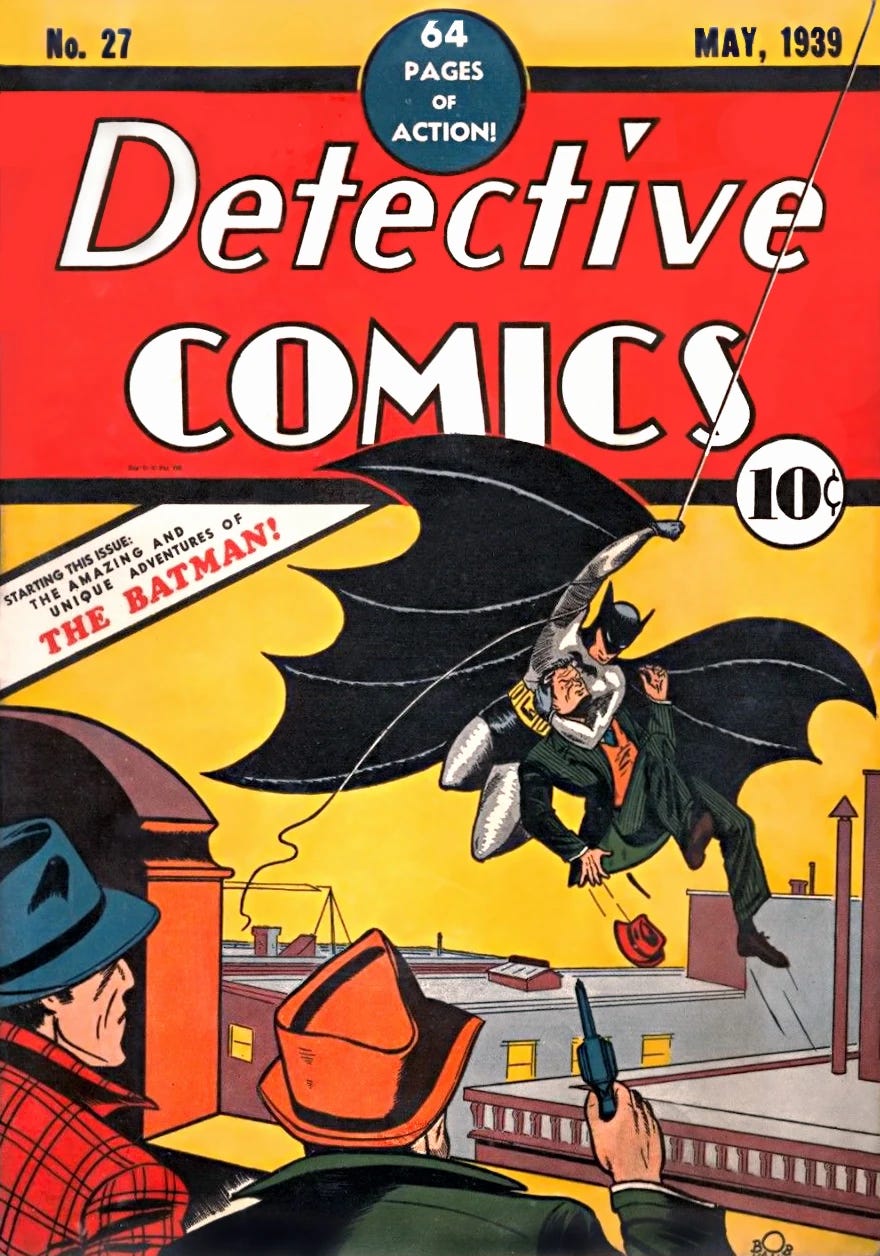
People ordinarily begin where something catches their interest, then work backward and outward. However, when we commonly give (or seek) advice, there can be the inclination to preface with the idea that we need to start at the very beginning. When that new comic fan asks where to start with Batman, I don’t tell them to check out Detective Comics #27 or Obadiah Oldbuck. Sure, there’s some important history and context to be had there, but time has revealed a better path.
In fact, starting in the middle isn’t an inferior substitute for starting at the beginning at all. It is perhaps the only way for the beginning to become meaningful.
The Difference Between Origins
There seems to me to be an astounding difference between the first event in a history of a topic and the true “origin story” of that thing. As I mentioned with Batman earlier, he may have initially appeared in Detective Comics #27, but the things that have become culturally significant with his origins are nowhere to be found.
We get Bruce Wayne, socialite and friend of Commissioner Gordon. We don’t, however, get the billionaire orphan or the Batcave. The issue ends with Batman punching the bad guy into a vat of acid1 and the reader learns his secret identity.
While just a few issues later we would learn of the death of Bruce Wayne’s parents, it would be nearly a decade before their killer had a name. This origin has been rewritten and retold countless times, and concepts that most would consider to be the core of the character appeared decades later.
The point is that when a story first appears, nobody knows which details will survive. Some traits disappear while others will be considered essential only after years of development. That first event becomes an origin only when later history points backward and identifies it as the beginning of something recognizable.
“When we want to see an oak with all its vigor of trunk, its spreading branches, and mass of foliage, we are not satisfied to be shown an acorn instead.” - G.W.F. Hegel, The Phenomenology of Spirit
Philosophically, I find the above comic analogy great to explain something that Hegel spoke to frequently. The truth of something only becomes intelligible through its development rather than being fully present in its earliest form. Hegel’s ideas on the development of history and people rely on this as well as consciousness itself.
We look back and can see the various branches of the tree that are now visible to us came from an initial acorn, and the path those branches took along the way looks different under each viewer’s perspective. Whether it is philosophy or the various writers tasked with taking a comic character forward, the details and story that speak to us from the past are unique to us and our inherited history.
Retroactive Meaning
“According to the standard view, the past is fixed, what happened happened, it cannot be undone, and the future is open, it depends on unpredictable contingencies. What we should propose here is a reversal of this standard view: the past is open to retroactive reinterpretations, while the future is closed, since we live in a determinist universe... This does not mean that we cannot change the future; it just means that, in order to change our future, we should first (not ‘understand’ but) change our past, reinterpret it in a way that opens up toward a different future from the one implied by the predominant vision of the past.” - Slavoj Žižek, The Parallax View
Perhaps the most important mechanism for understanding what I’m talking about here, is the idea that past can change. It is intuitive when we reflect upon the past and see all along how something was going to end up, but it goes beyond just the classic hindsight.
For Slavoj Žižek, following Hegel and the psychoanalysis of Lacan and Freud2, later developments can retroactively change the meaning of events that preceded them. Perhaps a new philosophy appears that builds upon ideas that had been all-but-forgotten.
This is not to say that later events physically change what happened. The change in meaning, however, isn’t arbitrary. The facts of the past couldn’t have decided upon their own significance at the time, because the consequences hadn’t unfolded yet. It is only through historical development that an outcome retrospectively establishes its own conditions.
Perhaps the best companion here is Jorge Luis Borges’ essay Kafka and His Precursors. In it, Borges has the brilliant insight that sometimes a work will come along that is so transformative that its precursors couldn’t have even been recognized for what they were before the work happened. Borges shows the chronological examples of the first “Kafkaesque” characters and ideas, going back to Aristotle and even ninth-century China.
Borges also identifies Kierkegaard, who of course has the famous line (shortened here) that is especially relevant to our discussion —
“Life can only be understood backwards; but it must be lived forwards.” - Søren Kierkegaard, 1843
Most importantly here, Borges explains that these precursors to Kafka, while being “Kafkaesque” themselves, were not necessarily similar to each other. It only became apparent that they shared such a quality after Kafka and his vision had arisen. Thus, later events not only inherit their influences and predecessors, but can create new ones by changing which earlier events appeared to anticipate them.
The Continuity of Comics
Newcomers to the comic world3 are often confused or even put off by the sheer volume of different runs, new origin stories, continuity resets, or retcons of the various characters and worlds. We can actually look at this through another lens and see it as an unusually clear model for making retroactive meaning visible by watching generations of readers and writers repeatedly reinterpret events.
Each new writer for a series inherits the original story plus the subsequent decades of additions, and likely earlier interpretations of the origin as well. The audience comes in with an already established understanding of the characters. The writer then returns to the beginning to ask which details were unimportant and which ones expressed what the story was really about. Then, in turn, the readers decide which of these origin stories or comic book runs resonate with them, and over time they become more or less popular among the community and may come to be treated as definitive interpretations.
There are two different X-Men series I am a fan of that serve as great examples of this.
First is X-Men: Grand Design.
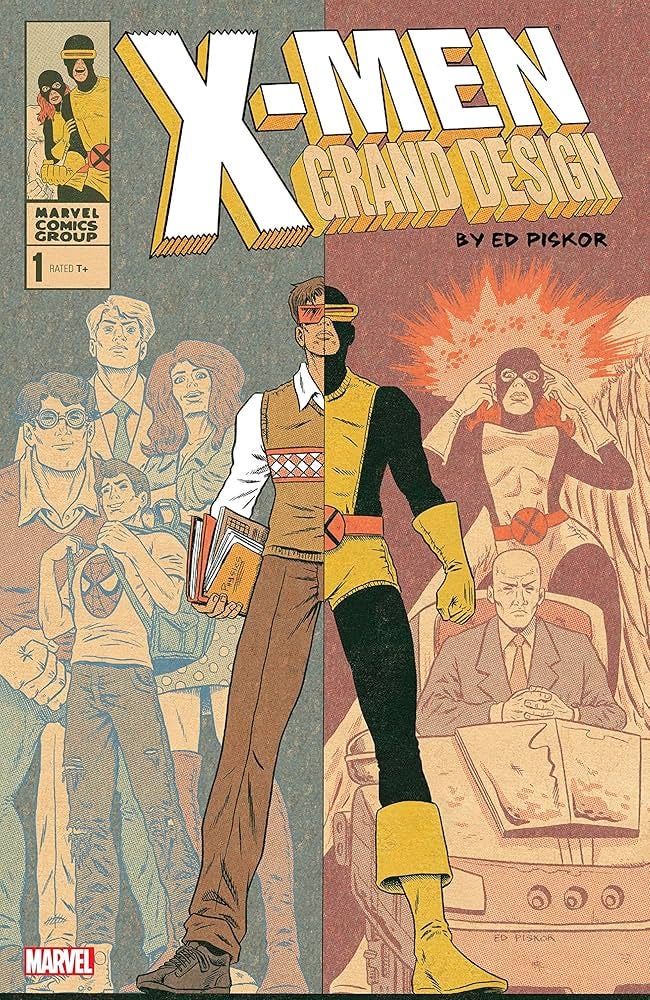
This was Ed Piskor taking the entirety of the X-Men history and rewriting and combining it “as if it was planned from the beginning.” Meaning that he combed through each different series and run by every previous writer and reorganized them into the version of the mutants’ history he thought it should be. It condenses everything down into one complete story from start to finish. So, while Grand Design can appear to look like it was planned from the very beginning, it required decades of work and development in this dialectic between previous writers and readers before the work could truly reveal itself.
Second are the X-Men: House of X and Powers of X stories.
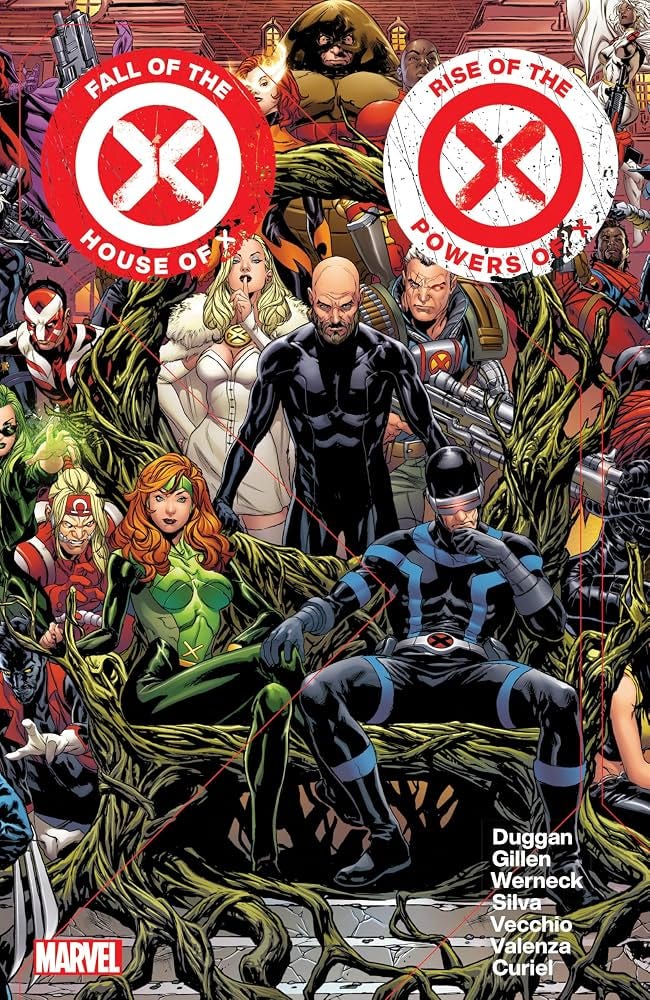
This is probably my favorite example. Not only does Jonathan Hickman, the writer, do what I’m talking about in taking from the legacy of the form and history of the X-Men to keep the details he wants, but the story itself includes this kind of retroactive meaning. House of X and Powers of X are two separate series but designed to be read together as an intertwined narrative. Without spoiling anything specifically, they reveal secret changes to characters that call the entire history of the X-Men universe into question.
The idea emerges that certain events can happen that make people question everything that led up to them. We have a certain idea about our past, but things could appear at any time that would radically alter the way we view things. Often, those radically different perspectives exist as lenses to view the past with regardless of whether we are aware of them or not.
The Retcon of History
We can thus apply the same mechanism to philosophical history. Philosophers are not just adding new ideas to an established sequence. Rather, they are reconstructing their own Grand Design of the tradition that came before them.
“It is the later that not only reveals the historical meaning of the earlier as precursor but also derogates the earlier as merely a precursor—”
- Hayden White, The Ethics of Narrative
The history of philosophy has partly been an argument over time about what philosophy has been about all along.
Nietzsche, in his On the Genealogy of Morality, confronts the evolution of ethics, reconstructing moral values and concepts to then end up becoming an immensely influential work in philosophy and psychology. We get to Hegel and he explains historical development through Spirit (Geist), the essence of reality that is itself this living process of retroactive development.
Then when Marx comes around Hegel’s work is transformed into a precursor of materialist social criticism. Žižek then uses his Lacanian psychoanalysis to read Hegel and Marx, transforming them both into his own philosophy of negation and contradiction.
While each of these thinkers is a Goliath in their own right, each of their “beginnings” was already a later interpretation of their own view on the past. In other words, later thinkers describe earlier philosophers as precursors to problems that only become fully articulated afterwards.
The Middle Path
The Greeks could not have been picturing themselves as the opening chapter of the modern philosophy curriculum. Retroactively they were assigned that role through institutions and philosophical systems4. Just as Superman could not have been predicted as the beginning of an unbelievably popular wave of superheroes. Perhaps they wouldn’t have given him all the powers if they had such foresight.
Returning to my idea of the newcomer starting with a spark of inspiration and wondering where to dive in, our philosophical journeys also can start the same way and we see a bit of a recursive method we can use. That initial interest may be a debate over freedom or even the fear of death.
We begin with a question that matters to us and then find the thinker who brings that question to life. We can then find their precursors, opponents, and the web of inspiration that may follow from them. Through following this historical context, we can then return to the original text or our first question and discover that our initial entrance point now means something new.
This is something I’ve been talking about since my first article here, with my commitment to recursive learning. Revisiting ideas as their contexts multiply rather than expecting a first pass to be final. The beginner’s starting point becomes an origin only retrospectively. Every serious education will of course hit those big foundational thinkers, but eventually returns us to where we began and reveals that we did not yet understand what was beginning.
“We define our identity always in dialogue with, sometimes in struggle against, the things our significant others want to see in us. Even after we outgrow some of these others — our parents, for instance — and they disappear from our lives, the conversation with them continues within us as long as we live.”
— Charles Taylor, The Politics of Recognition
The Personal Origin Story
Taking these ideas to their final expansion, we as humans reinterpret our lives in the same way that traditions reinterpret their beginnings. We might say that our career started as a childhood interest, or mark our biggest failure as a turning point toward redemption. We arrive in the middle of a story that we didn’t create, and we inherit relationships whose meaning remains unfinished.
This does not mean that later success proves earlier suffering was necessary, or that every failure was part of a plan. Retroactive meaning remains constrained by what actually happened, and no later interpretation can erase an injury or excuse an injustice. It means that an event does not exhaust its significance at the moment it occurs. What we do afterward can make an old event into something new even when nothing was settled in advance. The event itself didn’t secretly contain that future meaning, but the later developments gave it that place within the narrative of our lives.
Objection!
While I tried to cover potential opposition throughout the work, I want to concede a few points here. I understand that philosophical works respond to older concepts and debates. Without important historical context, we risk forcing present-day assumptions onto earlier thinkers, or even retreading old ground. Comic books, too, are diminished when we separate their characters and events from the storied history that gives them significance. I do think that chronology and historical context are important, and often they should take precedence in our learning journey.
My ideas on beginner jumping-on points are not meant to replace serious historical study. Beginners still need foundational reading, but that foundation itself may be understood best after the person has acquired a reason to care about it.
As for the analogy between philosophy, which is concerned with truth while comics are fiction — my point is the interpretation and continuity. We can argue over things being fictional or true, but I find that using fictional references is an incredible way to explain complex ideas without debasing the philosophy and still respecting the audience. Also, comics rule.
Conclusion
So, where should someone begin? Where we always do. Already present, in the middle of the action. We always enter traditions after they have already developed. Avoiding interpretation, arguments, commentaries, and context is impossible. Even primary sources or the first text will have acquired meaning that its author didn’t anticipate.
Philosophy and comic books survive by returning to their origins, inheriting them again, and discovering that the first story was never finished being written. Comic books help us to see this because they return to their origins so openly. History and philosophy perform the same movements whenever a new thinker combines the ideas that made their position possible.
We imagine that the beginning explains everything that follows. Often, everything that follows is what finally explains the beginning. We do not invent the events of our past, but what we do afterward helps determine what place those events will occupy in our lives.
These are my Lamentations of Late. Thanks for reading.
- JD
The iconic “vat of acid” does become an important mainstay in Batman history and is often used for the origin of the Joker.
Specifically the concept of Nachträglichkeit — when later understanding can attribute meaning or trauma to earlier events.
Excuse my speaking generally here when I’m mostly talking specifically about Superhero comic books. I could write at length about non-superhero comics and the differences there, and how they might find identity in other ways. A story for another day, perhaps.
Again, I make no argument that this is unfair. The Greeks are the Greeks for a reason, any serious philosophical study obviously includes them.
Unsurprisingly, another great post! I’m more of a Star Wars guy myself, but I’ve been known to dabble in Batman and had no idea that his parents dying and everything didn’t come until later. Fascinating. Also, the next chapter I’m posting today or tomorrow covers a lot of the same ground as this - the idea that the past is in some strange way dependent on how we perceive it in the present. Not that I should be surprised at this point when our writing serendipitously converges lol!